

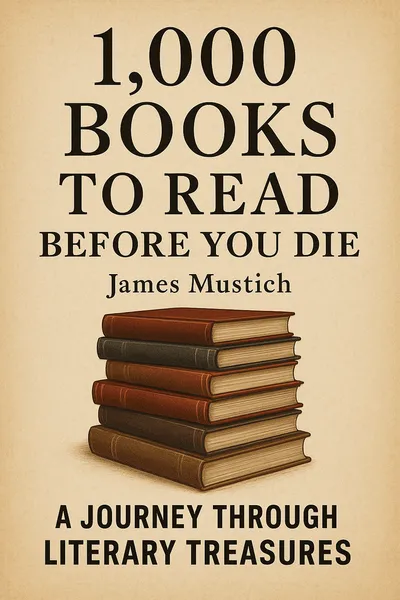
1,000 Books to Read Before You Die
A journey through literary treasures
Description
James Mustich presents an ambitious curatorial project that challenges conventional approaches to literary canon formation while simultaneously participating in the very tradition it critiques. Drawing upon his extensive background in independent bookselling and literary criticism, Mustich attempts to democratize the concept of essential reading by expanding beyond traditional Western literary hierarchies. The work emerges within contemporary debates about cultural authority, reading practices, and the role of literature in personal and collective identity formation. Rather than positioning itself as definitive cultural prescription, the compilation seeks to function as invitation and exploration, reflecting broader tensions between institutional literary authority and grassroots reading communities.
The work situates itself within ongoing scholarly discourse regarding canon revision while maintaining accessibility for general audiences, thus occupying a unique position between academic literary criticism and popular cultural commentary. Mustich's central research question asks: How can literary recommendation transcend traditional canonical boundaries while maintaining cultural coherence and personal meaning? His defended thesis argues that literary value emerges through diverse reading experiences that bridge conventional distinctions between high and popular culture. The main stake demonstrates that inclusive, personally meaningful reading lists can enhance rather than diminish literary appreciation and cultural understanding.
Mustich's project represents sophisticated attempt to reconcile democratic impulses with curatorial responsibility, creating framework for literary engagement that honors both individual choice and collective wisdom. The work successfully demonstrates that inclusive approaches to canonical formation can enhance rather than diminish literary appreciation by expanding possibilities for meaningful encounter. The compilation's strength lies in its recognition that contemporary readers require guidance that acknowledges both global literary diversity and personal reading contexts. By refusing to impose rigid hierarchies while maintaining quality standards, Mustich creates space for exploration that serves both individual growth and cultural continuity.
Table of contents
01Democratic Canon Formation and Cultural Authority
Mustich's approach fundamentally challenges traditional mechanisms of literary authority by proposing that canonical value emerges through reader engagement rather than institutional decree. This democratic impulse reflects broader cultural shifts toward participatory meaning-making while simultaneously raising questions about the sources and legitimacy of cultural guidance. The author navigates the paradox of rejecting hierarchical authority while necessarily exercising curatorial judgment, creating tension between egalitarian ideals and practical necessity.

02Inclusivity Versus Coherence in Literary Selection
The expansive scope of Mustich's recommendations reveals sophisticated understanding of how contemporary readers navigate between different literary traditions and genres. By including works spanning multiple centuries, cultures, and forms, the compilation reflects globalized reading practices while raising questions about coherence and progression in literary education. This inclusivity serves both pedagogical and political functions, challenging readers to expand their perspectives while acknowledging diverse cultural contributions to human knowledge and artistic expression.
03Personal Discovery and Institutional Guidance
Mustich's emphasis on personal discovery challenges conventional educational approaches that prioritize structured progression through established literary traditions. This individualistic approach reflects contemporary therapeutic culture's emphasis on self-actualization through consumption choices while raising questions about the relationship between personal fulfillment and cultural coherence. The author suggests that meaningful reading emerges through serendipitous encounter rather than systematic study, positioning literature as exploration rather than education.
04Cultural Memory and Contemporary Relevance
The compilation functions as both preservation mechanism and innovation tool, maintaining cultural memory while adapting to contemporary needs and perspectives. This dual function reflects broader challenges facing cultural institutions in rapidly changing social contexts. Mustich's selections attempt to balance historical significance with current accessibility, suggesting that cultural transmission requires constant reinterpretation rather than static preservation.
05Critical Assessment and Future Directions
The work's primary limitation emerges from its inability to fully resolve tensions between democratic ideals and practical necessities of selection. Despite inclusive intentions, Mustich's choices inevitably reflect his particular cultural position and aesthetic preferences, suggesting that truly neutral curation remains impossible. The compilation would benefit from more explicit acknowledgment of its own cultural situatedness and the partial nature of all canonical judgments.
The emphasis on breadth potentially undermines depth of engagement, risking superficial encounter with complex traditions. Future work might explore how inclusive approaches can maintain intellectual rigor while expanding cultural representation. Additionally, the static nature of book recommendations raises questions about adaptation to rapidly changing technological and social contexts.