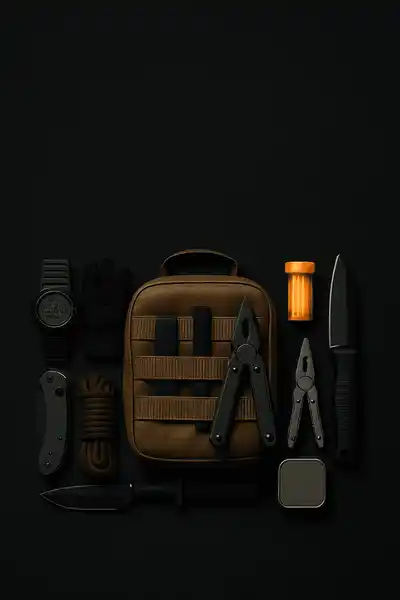
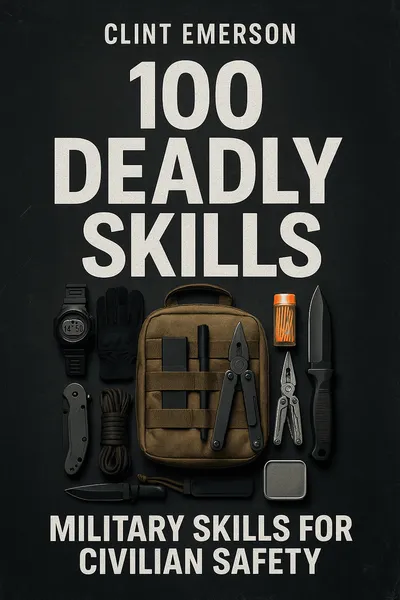
100 Deadly Skills
Military skills for civilian safety
Description
Emerson's work emerges within the contemporary landscape of survival literature, positioning itself at the convergence of military expertise and civilian security concerns. The author leverages his extensive special operations background to construct a comprehensive manual addressing urban survival challenges. This publication reflects broader societal anxieties regarding personal security in an increasingly uncertain world, capitalizing on post-9/11 security consciousness and the popularization of tactical culture in mainstream discourse.
The book's central research question asks: How can military-derived tactical skills be adapted and applied to enhance civilian survival capabilities in dangerous urban environments? Emerson's defended thesis posits that contemporary civilian life requires systematic preparation through military-grade tactical knowledge to navigate emerging security threats effectively. The main stake involves democratizing elite military survival techniques to empower ordinary citizens with enhanced personal security capabilities.
Emerson's work represents a significant contribution to contemporary survival literature through its systematic presentation of military-derived tactical knowledge for civilian applications. The author successfully translates complex operational techniques into accessible formats while maintaining technical rigor. The work's strength lies in its comprehensive scope and practical applicability, offering readers concrete skills for enhanced personal security. However, the underlying premises of the work reflect specific ideological assumptions about contemporary threats and appropriate responses. The author's framework prioritizes individual preparedness over collective security solutions, potentially reinforcing social fragmentation trends.
Table of contents
01 The Militarization of Civilian Preparedness
Emerson's theoretical framework fundamentally rests upon the transposition of military tactical doctrine into civilian contexts. This conceptual migration reflects broader cultural phenomena wherein military methodologies increasingly penetrate non-military spheres. The author's approach embodies what could be termed "tactical evangelism," promoting the systematic adoption of special operations principles as solutions to everyday security concerns.

02 The Construction of Urban Threat Narratives
The author's presentation of urban environments as inherently dangerous battlefields reflects specific ideological frameworks about modern society. Emerson constructs a worldview wherein ordinary citizens must constantly prepare for hostile encounters, surveillance, and potential capture scenarios. This perspective transforms everyday urban spaces into potential theaters of conflict requiring military-level preparedness.
03 Knowledge Transfer and Skill Democratization
The work raises critical questions about the appropriate boundaries of specialized knowledge dissemination. Emerson's project involves declassifying and popularizing techniques developed for highly trained military professionals operating in extreme circumstances. This knowledge transfer process necessitates significant adaptation and simplification, potentially compromising the effectiveness and safety of such techniques when applied by untrained civilians.
04 Ethical Implications and Social Consequences
The ethical dimensions of popularizing military survival techniques demand careful examination. Emerson's approach implicitly promotes a worldview wherein individuals must assume primary responsibility for their own security through potentially aggressive or deceptive means. This philosophy aligns with broader neoliberal trends emphasizing individual responsibility over collective social protection mechanisms.
05 Critical Assessment and Future Directions
The work's primary limitation lies in its insufficient engagement with the broader social implications of widespread tactical training. Emerson fails to adequately address potential negative consequences of normalizing military techniques in civilian contexts. Additionally, the author's threat assessment appears somewhat hyperbolic, potentially fostering unnecessary paranoia among readers. The work would benefit from more nuanced discussion of when such techniques are appropriate versus excessive.
Related books