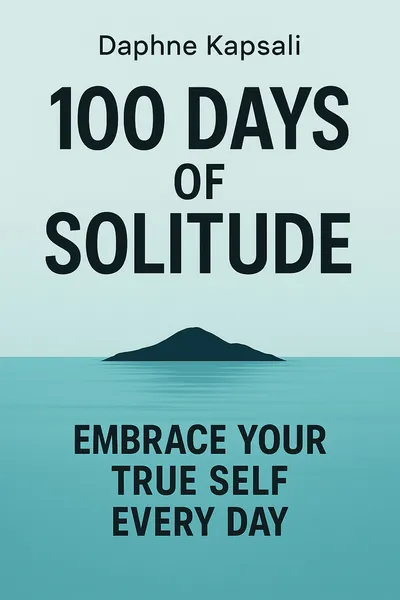
100 days of solitude
Embrace your true self every day
Description
Daphne Kapsali's "100 Days of Solitude" presents a compelling thesis that voluntary solitude represents not an escape from life but a profound engagement with existence that can catalyze personal transformation and authentic self-discovery. The work emerges within contemporary debates surrounding digital hyperconnectivity and the pathologization of solitude in modern society. Writing against a backdrop of increasing social anxiety and enforced isolation experiences during global disruptions, the author positions her ethnographic self-study as both personal journey and sociological experiment. The work contributes to growing literature questioning the mandatory nature of constant social engagement while drawing from phenomenological traditions that privilege lived experience as valid epistemological ground.
Kapsali's central research question asks: Can deliberate solitude serve as a legitimate path toward psychological integration and social understanding? Her defended thesis argues that extended voluntary isolation, when approached with intentionality, generates profound insights into authentic selfhood and social conditioning. The main stake involves rehabilitating solitude as a valuable practice rather than a pathological condition or social failure.
The work successfully presents a case for reconceptualizing solitude within contemporary psychological and social frameworks. Her integration of phenomenological analysis, social critique, and creative exploration demonstrates solitude's multifaceted benefits while acknowledging its challenges and limitations. The author successfully challenges dominant assumptions about human social needs, proposing that voluntary isolation represents a legitimate developmental practice rather than pathological avoidance. Her methodology—combining rigorous self-observation with theoretical analysis—offers a model for understanding subjective experiences within broader cultural contexts.
Table of contents
01 The Phenomenology of Chosen Isolation
Kapsali employs existential phenomenology to examine the qualitative dimensions of voluntary retreat, challenging dominant narratives that equate solitude with loneliness or social dysfunction. Her analysis reveals solitude as an active practice requiring psychological courage and methodological rigor. The author demonstrates how removing external social stimuli creates space for encountering previously unconscious aspects of selfhood, including suppressed emotions, creative impulses, and existential anxieties.

02 Social Conditioning and the Authentic Self
The work's second analytical axis examines how social immersion creates layers of performative identity that obscure authentic selfhood. Kapsali argues that constant interpersonal interaction generates what she terms "social static"—the accumulated noise of external expectations, social roles, and cultural programming that prevents genuine self-encounter. Through sustained isolation, these conditioned responses gradually dissolve, revealing core personality structures and intrinsic motivations.
03 Creativity and the Solitary Mind
Kapsali explores the relationship between solitude and creative expression, arguing that isolation provides optimal conditions for innovative thinking and artistic production. Her analysis reveals how social interaction, while valuable, can create cognitive interference that inhibits original thought processes. The solitary mind, freed from immediate social feedback loops, develops different patterns of association and imagination.
04 Ethical Implications and Social Responsibility
The final analytical dimension addresses potential criticisms that voluntary solitude represents social escapism or privilege. Kapsali confronts this ethical challenge by examining how solitary practice can enhance rather than diminish social contribution. Her analysis suggests that individuals who have undergone intensive self-examination through isolation often return to social engagement with greater empathy, clearer boundaries, and more authentic communication styles.
05 Critical Assessment and Future Directions
The work's primary limitation lies in its necessarily subjective scope, which limits generalizability across different personality types, cultural backgrounds, and socioeconomic circumstances. Kapsali's privileged position—having resources and freedom to undertake extended isolation—raises questions about the accessibility of her recommendations. The analysis would benefit from engagement with involuntary isolation experiences and consideration of how solitude's effects might differ across diverse populations.
Related books