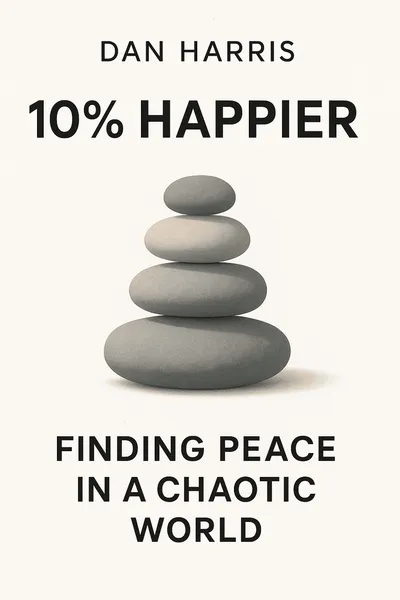
10% Happier
Finding peace in a chaotic world
Description
Harris presents a pragmatic exploration of meditation's utility for high-achieving professionals skeptical of spiritual practices. Writing from his position as a network news anchor, he addresses the intersection between ancient contemplative traditions and contemporary workplace demands. The work emerges from Harris's personal experience with panic attacks and subsequent discovery of meditation as a practical tool rather than mystical practice. This positioning challenges traditional boundaries between secular achievement culture and contemplative practices, offering meditation as professional development rather than spiritual journey.
The central research question examines whether meditation practices can be effectively integrated into high-pressure professional environments without compromising competitive performance. Harris defends the thesis that mindfulness meditation offers measurable improvements in stress management and decision-making while maintaining professional effectiveness and ambition. The main stake involves demonstrating that contemplative practices can enhance rather than diminish professional performance, particularly for skeptical, achievement-oriented individuals.
Harris presents meditation as pragmatic tool for professional optimization rather than path toward fundamental life transformation. His approach successfully bridges contemplative practice with secular achievement culture, potentially expanding meditation's accessibility to skeptical audiences. The work's strength lies in its practical demonstration that ancient practices can provide measurable benefits within contemporary professional contexts without requiring radical lifestyle changes. The narrative's coherence emerges from its consistent positioning of meditation as enhancement rather than alternative to competitive professional life. Harris maintains that contemplative practice can improve decision-making, reduce stress, and increase effectiveness while preserving ambition and drive. This synthesis offers a middle path between traditional spiritual approaches and pure secular productivity enhancement.
Table of contents
01 The Commodification of Contemplative Practice
Harris's approach represents a significant commodification of traditional Buddhist meditation practices, stripping them of spiritual context to serve secular professional needs. This transformation reflects broader cultural tendencies to instrumentalize ancient wisdom traditions for contemporary productivity enhancement. The author's emphasis on measurable outcomes and practical benefits mirrors neoliberal discourse that values practices primarily for their economic utility rather than intrinsic worth.

02 Masculinity and Emotional Regulation in Professional Contexts
The narrative constructs a particular model of professional masculinity that acknowledges emotional vulnerability while maintaining competitive edge. Harris's account of panic attacks and subsequent meditation practice challenges traditional masculine norms around emotional expression while preserving elements of professional dominance and control. This tension reveals contemporary struggles to reconcile authentic emotional experience with professional performance expectations.
03 The Politics of Secular Mindfulness
Harris's secular appropriation of Buddhist practices raises significant questions about cultural extraction and the politics of spiritual commodification. The removal of ethical teachings and philosophical context from meditation techniques reflects broader patterns of Western consumption of Eastern wisdom traditions. This approach prioritizes technique over transformation, potentially undermining meditation's capacity for fundamental worldview shifts.
04 Individual Solutions to Systemic Problems
Harris's focus on personal meditation practice as stress management solution reflects broader neoliberal tendencies to privatize responsibility for structural problems. Rather than examining workplace conditions that generate excessive stress and anxiety, the narrative positions individual contemplative practice as sufficient response to systemic issues. This framework may inadvertently support exploitative work environments by providing workers with coping mechanisms rather than advocating for structural change.
05 Critical Analysis and Future Directions
The work's primary limitation lies in its instrumental approach to contemplative practice, which may restrict meditation's deeper transformative potential. Harris's emphasis on maintaining competitive edge while practicing meditation reflects incomplete integration of contemplative wisdom, potentially preserving problematic aspects of achievement-oriented culture. The selective appropriation of Buddhist techniques while rejecting associated ethical teachings raises questions about the sustainability and authenticity of such approaches.
Additionally, the focus on individual solutions to stress may inadvertently support systemic workplace problems by providing coping mechanisms rather than encouraging structural reform. The narrative's appeal to scientific validation, while broadening accessibility, potentially reinforces colonial attitudes toward non-Western knowledge systems.
Related books