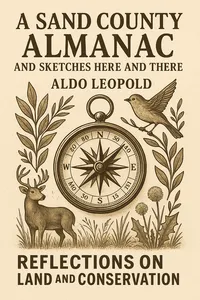
Aldo Leopold
About the author
Aldo Leopold (1887-1948) was an American forester, philosopher, educator, writer, and environmentalist. Educated at Yale Forest School, he began his career with the U.S. Forest Service, where he developed early wilderness preservation concepts. Leopold later became a professor of wildlife management at the University of Wisconsin-Madison, pioneering the field of wildlife ecology. His academic contributions include foundational work in forest management and conservation biology. Prior to A Sand County Almanac, he published extensively on wildlife management and conservation policy, establishing himself as a leading voice in American environmental thought. His interdisciplinary approach bridged scientific methodology with ethical philosophy, profoundly influencing modern environmental consciousness.
Leopold's intellectual contribution lies in demonstrating how environmental problems require ethical rather than merely technical solutions. By revealing the inadequacy of anthropocentric worldviews, Leopold opens space for alternative frameworks that recognize ecological interdependence and intrinsic value in natural systems. His integration of scientific and ethical thinking provides a model for addressing contemporary environmental challenges. The work achieves remarkable coherence by integrating scientific observation, philosophical reflection, and practical wisdom, with an argument that progresses logically from phenomenological observation through ethical critique to constructive proposals for cultural transformation.